Last Updated on October 26, 2026 by Luxe
Table of Contents
- Set a Complete Coastal Home Budget
- Check Flood Exposure Before Falling in Love With a Property
- Get Insurance Quotes Early
- Inspect for Coastal Wear
- Review HOA, Condo, and Rental Rules
- Compare Properties Using More Than Asking Price
- Match the Home to Your Main Goal
- Visit at Different Times
- Choose Local Guidance With Coastal Experience
- Build a Careful Offer and Due-Diligence Plan
- Common Questions Coastal Buyers Ask
- Final Checklist Before Making an Offer
Buying near the coast in Pawleys Island, Murrells Inlet, Georgetown, Garden City, or another Grand Strand community means looking beyond the view. Salt air, storm exposure, drainage, humidity, insurance requirements, and seasonal activity can all affect the cost and day-to-day experience of owning a home.
For buyers who want an area-specific perspective, Pawleys Island, SC real estate agents Taylor Keenan Team offer property search, buyer representation, valuation insight, and local market guidance for Pawleys Island and the wider Grand Strand. The Taylor Keenan Team is a Pawleys Island-based real estate group serving buyers, sellers, and investors who need to evaluate both a property and the surrounding coastal community before moving forward.
1. Set a Complete Coastal Home Budget
The listing price is only one part of the decision. Build a working budget that includes the mortgage payment, property taxes, utilities, association or regime fees, routine maintenance, and travel expenses if the home will be a second residence. Then account for insurance, which may include homeowners coverage, flood coverage, wind and hail protection, and umbrella liability coverage when appropriate.
Keep reserves beyond the down payment and closing costs. A roof repair, HVAC replacement, storm deductible, drainage improvement, or special assessment can change the financial picture quickly. A lender’s maximum approval amount is useful, but a lower payment that leaves room for maintenance and savings may be the more comfortable choice.
2. Check Flood Exposure Before Falling in Love With a Property
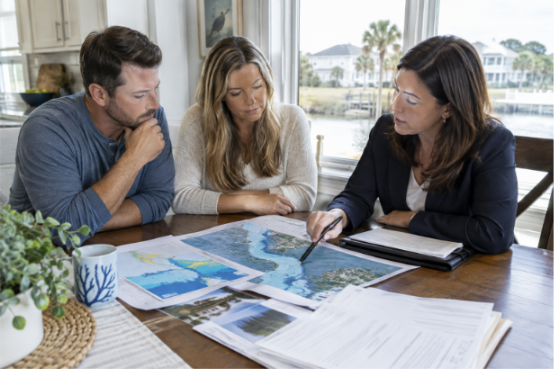
Flood exposure can differ between homes that appear similar on a map or sit only a few blocks apart. Review the current flood zone, property elevation information, surrounding drainage, crawl-space condition, and any known history of water intrusion. The South Carolina flood map resources explain how to find FEMA mapping information and view flood-zone data by address.
A map is a starting point, not a final answer. Ask whether an elevation certificate is available, whether drainage work has been completed, and whether the seller has records related to flooding, water entry, or insurance claims. An insurance professional can provide property-specific guidance that a map alone cannot provide.
3. Get Insurance Quotes Early
Request preliminary insurance quotes while evaluating a specific home, ideally before removing major contract protections. Premiums may vary based on elevation, roof age, replacement cost, building materials, distance to water, claims history, and the coverage selected. Ask about named-storm deductibles, limits, exclusions, and whether a policy contains gaps that would leave you responsible for a major expense.
4. Inspect for Coastal Wear
Coastal weather can be hard on exterior materials and mechanical systems. A general home inspection should closely consider roof age and repairs, HVAC corrosion, windows and doors, storm protection, foundation supports, crawl spaces, plumbing, electrical panels, decks, railings, siding, trim, fasteners, and signs of termite or wood damage.
Some properties warrant additional specialists. Consider separate evaluations for a dock, seawall, septic system, pool, older roof, major renovation, or unusually complex drainage issue. Inspection findings are most useful when paired with estimates for necessary repairs and a realistic timeline for completing them.
5. Review HOA, Condo, and Rental Rules
Community documents can shape how you use the home and how appealing it may be to a future buyer. Review declarations, bylaws, budgets, meeting minutes, insurance information, reserve funding, and any recent or planned assessments. Confirm rules for short-term rentals, pets, parking, boats, golf carts, exterior improvements, fences, pools, decks, and landscaping.
For condominiums, pay particular attention to the master insurance policy, reserve balance, building maintenance responsibilities, and pending capital projects. Lower monthly fees are not automatically better if essential repairs have been deferred.
6. Compare Properties Using More Than Asking Price
Compare recent closed sales rather than relying only on active listings. Look at location, access, lot characteristics, construction, condition, parking, storage, water or beach access, roof and HVAC age, association fees, and likely insurance availability. The least expensive property to buy is not always the least expensive to own.
7. Match the Home to Your Main Goal
A primary residence should fit year-round needs such as groceries, health care, work routes, schools, and services. Second-home buyers should think about security, maintenance support, travel time, and storm preparation when they are away. Investors should verify rental rules, management costs, cleaning expenses, taxes, occupancy assumptions, and periods without guests before relying on projected income.
8. Visit at Different Times
Try to visit on a quiet weekday and during a busier weekend. Drive the routes you would use for groceries, medical appointments, beach access, and dining. Check traffic, noise, parking, nearby construction, cell service, internet options, walkability, bike access, and road conditions after heavy rain if possible. A community can feel very different during peak vacation periods than it does in the off-season.
9. Choose Local Guidance With Coastal Experience
Coastal transactions often require more detailed questions about insurance, inspections, flood exposure, comparable sales, community restrictions, and seasonal conditions. An agent with relevant local experience can help organize those questions, identify useful documents, and compare homes on ownership factors that may not be obvious from listing photos.
10. Build a Careful Offer and Due-Diligence Plan
Before submitting an offer, understand the deadlines for inspections, financing, appraisal, insurance, and document review. Discuss appropriate contract terms with your real estate professional and attorney. If the home has an aging roof, high insurance costs, a pending assessment, or needed drainage work, those items should inform both your offer and your due-diligence plan. Do not waive important protections without understanding the risk involved.
Common Questions Coastal Buyers Ask
What costs do buyers often underestimate?
Insurance, association fees, replacement of major systems, storm deductibles, special assessments, and ongoing exterior maintenance are frequent budget considerations.
Should buyers avoid flood zones?
Not necessarily. The decision depends on the home’s elevation, insurance cost, financing, intended use, condition, and the buyer’s comfort with risk. A flood-zone designation should prompt deeper research rather than an automatic rejection.
Is a condo easier to maintain than a detached home?
A condo may reduce personal responsibility for exterior work, but buyers should weigh association fees, rental restrictions, reserve funding, master-policy coverage, and the possibility of special assessments.
Final Checklist Before Making an Offer
- Confirm the full monthly and annual ownership cost.
- Review homeowners, flood, wind, and hail insurance options.
- Check flood maps, elevation details, drainage, and water-history records.
- Inspect the roof, HVAC, windows, foundation, crawl space, plumbing, and electrical systems.
- Read HOA, condo, rental, reserve, and assessment documents.
- Compare the home with recent nearby sales and similar ownership costs.
- Verify permits for additions, decks, pools, docks, and major renovations.
- Set aside funds for repairs, deductibles, and storm preparation.
Coastal homeownership can be deeply rewarding when the purchase fits more than a lifestyle vision. A careful review of budget, insurance, flood exposure, condition, community rules, and long-term plans helps buyers choose a South Carolina coastal home with greater confidence.
Read more: Navigating the Real Estate Landscape: The Importance of Due Diligence Reports for Minimizing Risks