Last Updated on August 25, 2026 by Luxe
Every lash artist has experienced it: one day your adhesive holds like magic, and the next day you are struggling with poor attachment, shock curing, or endless stickies. The culprit is rarely a bad batch of glue. Most often, it comes down to room conditions.
Understanding how temperature and humidity interact with your lash glue is essential for maintaining consistent curing speeds, seamless application, and long-lasting retention. Here is a comprehensive guide from your go-to lash supply store on managing your workspace environment for optimal performance.
How Lash Adhesive Cures
To master your adhesive, you first need to understand the science behind how it cures. Lash adhesives are formulated with cyanoacrylate, an acrylic resin that reacts instantly upon contact with moisture.
● The Polymerization Process: Cyanoacrylate does not dry through evaporation like water-based paints. Instead, it undergoes a chemical process called polymerization, where liquid monomers form strong polymer chains to create a solid bond.
● The Role of Moisture: Ambient humidity acts as the natural catalyst for this reaction. Water molecules present in the air kickstart the polymerization process, determining how fast or slow the glue sets.
What Is the Best Humidity for Lash Extensions?
There is no single “magic” humidity level that works for every salon or lash tech.
● No Universal Standard: Most standard cyanoacrylate adhesives thrive in a relative humidity range of 45% to 60%. However, specialized fast-drying or high-humidity formulas might target different ranges.
● Follow Manufacturer Instructions: Always check the specific recommended range provided on your glue bottle. Operating outside the manufacturer’s specified parameters directly compromises bond strength and retention.
What Happens When Humidity Is Too High?
When the moisture content in your lash room spikes above your glue’s ideal threshold, curing accelerates rapidly.
● The Adhesive Cures Too Quickly: High moisture forces the glue drop to polymerize on contact with the air before you even touch the natural lash.
● Poor Attachment: If the glue partially sets while moving the extension from the lash palette to the natural lash, it creates a weak, brittle bond that will shed prematurely.
● Shorter Working Time: Your glue drop on the jade stone or ring will skin over much faster, requiring frequent fresh drops.
What Happens When Humidity Is Too Low?
When air moisture drops below recommended levels, the polymerization process stalls.
● Slow Curing: The adhesive remains wet and tacky far longer than expected, leading to sliding extensions.
● Stickies and Poor Isolation: Slow-drying glue increases the risk of neighboring lashes sticking together, ruining isolation work.
● Longer Exposure to Fumes: When adhesive stays liquid longer, it off-gases for an extended period, increasing the likelihood of client eye irritation or allergic reactions.
How Temperature Changes Adhesive Performance
While humidity controls curing speed, temperature dictates the viscosity (thickness) of your lash adhesive:
● High Temperature: Heat thins out the liquid, making the adhesive runny. Thin glue absorbs room moisture faster, accelerating curing speeds even further.
● Low Temperature: Cold environments thicken the adhesive, making it viscous and sluggish to dry. Thick glue can create bulky, heavy bases at the natural lash line.
How to Control Lash-Room Conditions
Taking control of your environment requires daily monitoring and the right studio equipment.
● Use a Digital Hygrometer: Keep a hygrometer directly at your lash station, not across the room, to measure real-time temperature and humidity right where you work.
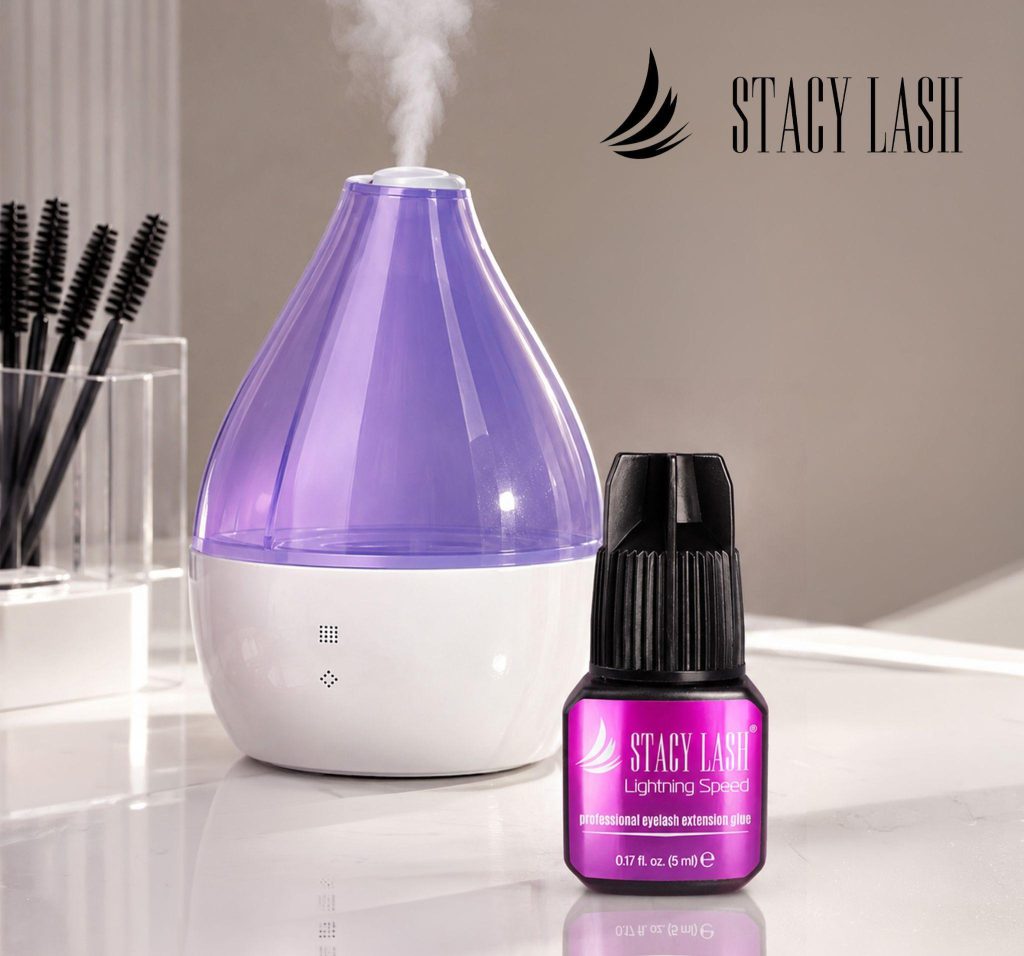
● Deploy Climate Tools: Use a dedicated humidifier if your room is too dry, or a dehumidifier/AC unit if your environment is overly humid.
● Store Adhesive Correctly: Keep unopened bottles in a cool, dark place (or a sealed vacuum container with silica packs). Store opened bottles upright in an airtight container away from direct sunlight.
● Replace Glue Drops Regularly: Dispense a fresh drop of glue every 15 to 30 minutes (or sooner in high humidity) to ensure you are always dipping into active, unpolymerized adhesive.
How to Match Adhesive Speed to Your Technique
Your ideal adhesive depends on your personal speed as a technician:
● Beginner/Intermediate Techs: If you are still refining your isolation speed, opt for a medium-drying adhesive (1–2 seconds) in a moderate humidity environment so you have time to adjust placement.
● Advanced Techs: High-speed artists benefit from ultra-fast adhesives (0.5–1 second) paired with optimal humidity to lock in sets without slowing down.
Lash-Room Environment Checklist
Before starting your first client of the day, run through this quick workspace check:
| Action Item | Target / Status |
| Check Digital Hygrometer | Humidity within manufacturer range (e.g., 45%–60%) |
| Verify Room Temperature | Comfortable range (68°F–72°F / 20°C–22°C) |
| Adjust Climate Controls | Turn on humidifier or AC/dehumidifier as needed |
| Prep Fresh Adhesive | Shake bottle thoroughly for 30–60 seconds |
| Monitor Glue Drop | Refresh drop every 15–30 minutes during service |
Read More : Castor Oil for Hair Growth: Fact or Myth?